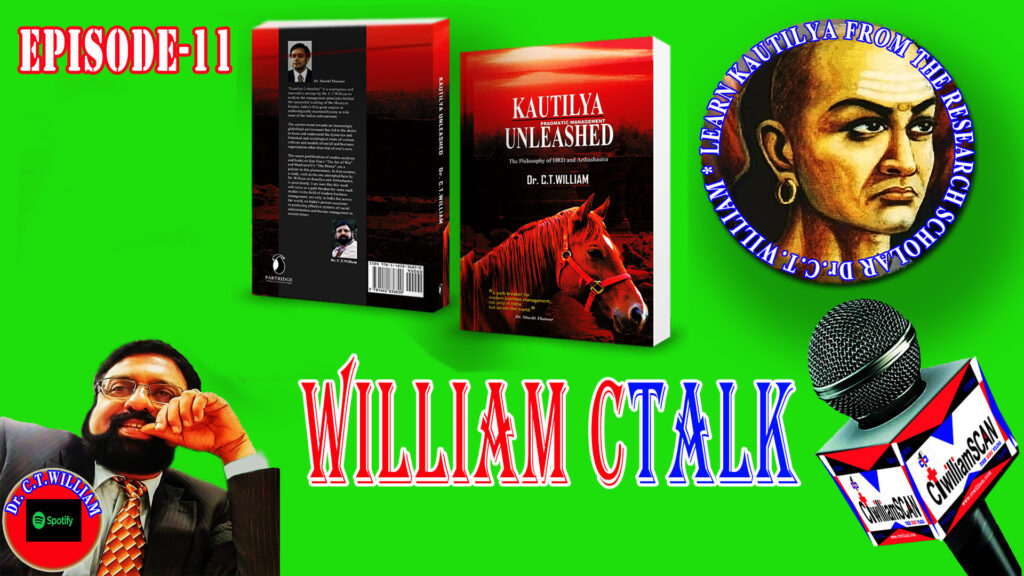
Research scholars have thus explored the precious archives of the time and found that Kautilya was also known as Vishnugupta, Chanakya, Dhramila and Angula. The slokas from Thrikandasesham of Purushothama Devan support this multi-nomenclature of Kautilya. Listen William CTALK
Vishnuguptasthu kautilyaschanakyo dhramilangula:
Thrikandasesham
Purushothama Devan
However, the scholars have derived an inference that the name ‘Kautilya’ is the most acceptable one as he belongs to the Gothra of Kutala and son of Hrishi Chanaka lived in the Chanaka dhesa.
There is a lot of disagreement and puzzlement among scholars about the date of composition of the Arthashastra and the exact period of Kautilya. This is due to the collisions and interpolations of data about the society and the customs and manners followed by the people in the Arthashastra. This society is seen to have been influenced by the culture of Pre-Buddhism and experienced the continuum of the culture of the later period of Manusmriti. L.N. Rangarajan quotes, “though Kautilya wrote long after the time of Buddha, who died in 486 B.C., the state of society portrayed in the Arthashastra is, in the main, pre-Buddhistic. On the other hand, the norms under which Hindu society has functioned for the last two millennia are those of Smritis; the earliest and most important of these, the Manusmriti, was codified sometime in the first two centuries AD..
In fact, it is the comparison of the data in the Arthashastra with that in other works and the question of who borrowed from whom that prompts scholars to ascribe different dates to the Arthashastra itself”. At the same time, we have also some authentic reference to Arthashastra from the well-known Dasakumaracharitham written by Dhandi in AD 700.
Adheeswa thavaDhandaneetham:
Iyamidhaneemacharya vishnuguptenu
Mauryartha shadbee
Sloka sahasraia samshiptha
It is translated that ‘the science of Politics and Economics was abridged by Vishnuguptacharya (Kautilya) in six thousand Granthas (Sutras) for the guidance of the Mauryans, in the hope that a well-digested study of, and administration according to the precepts of the Arthashastra will enable the king to conduct his rule with brilliant success’. (Dr. R. Shamashastry, Kautilya’s Arthashastra, The Indian Antiquary, A Journal Of Oriental Research, Vol. XXXIV, 1905).

Writing is the intellectual interpretation of vision. Vision is the window open to philosophy. This is the scriptural metamorphosis of Dr. C.T. William’s writing. It was this scriptural phenomenon that inspired Dr. C.T. William to write several of his remarkable literary works. Being an Indian writer who blossomed in the Gods' own country, Kerala, his literary creations are debated among the chosen intellectual minority rather than the elected popular majority.
C.T. William has nine books to highlight his literary splendors. Manava Vibhava Vikasana Thathwachinthayum Arthashastravum (Malayalam: Philosophy, 2005, Publishers: Kerala Sahithya Academy, Thrissur), Ithuvare (Malayalam: Poems, 2009, Publishers: Current Books, Thrissur), Shabdham Ayodhya Vare Ethumbol (Malayalam: Criticism, 2011, Publishers: Sign Books, Thiruvananthapuram), Vilapatthinte Ilakal (Malayalam: Poems, 2013, Publishers: Maluben Books, Thiruvananthapuram), Nakshathrangal Chuvakkunnilla (Malayalam: Travelogue, 2013, Publishers: Dharmartham Books, Thrissur), Shesham Sheshan (Malayalam: Biography, 2013, Publishers: Mathrubhumi Books, Kozhikode), Kautilya Unleashed (English: Management, 2014, Publishers: Partridge India, A Penguin Random Company), Seethamar Karayukayaanu (Seetha is crying), (Malayalam: Poems, 2018: Publishers: Mentor Books, Thrissur) and Swargeeya Narakam (The heavenly Hell), (Malayalam: Travelogue, 2018: Publishers: Mentor Books, Thrissur).
It was Dr. C.T. William’s unquenchable thirst for pragmatic philosophy that resulted in the writing of the book "Kautilya Unleashed" (published by Partridge India). The practical philosophy he invented and got inspired by the philosophy of human resource development that is inherent in the great Indian classic Arthashastra of Kautilya-the cosmic guru who wrote the Bible of administration and Management.
This book is an authentic guide and hand book for the global citizen to lead a successful life personal, political as well as organizational by applying the gospels of Human Resource Development and Management that have deep-rooted in the Oriental Philosophy. It is the Bible of management, specifically of human resource development. It consists of the gospels of administration, political diplomacy, philosophy of human resource development, economics, psychology of society, and the ethics of war and peace.
"The book Kautilya Unleashed will appeal to readers because it is an essential practical guide for global citizens, students of management, and the leaders of the world," Dr. William said. " Compared to other books of its kind, it is a simplified version of philosophic management thoughts in which students of management and general readers could easily follow and encapsulate," he added.
"Kautilya Unleashed" is the fruitful effort of a decadal intellectual meditation of the author. It will energise the readers and inspire them to work for the reconstruction of themselves, their society, nation, and the world.